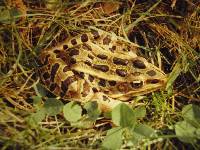
Description: The leopard frog is a green or brown frog that has dark spots on its back and legs. Dorsolateral folds are present. Length: Typically, 2 to 3.5 inches. Color: Brown or green with two or three rows of irregularly spaced dark spots. Spots are rounded and have light borders. There are two color mutations of the leopard frog in Minnesota: the Burnsi leopard frog which lacks spots, and the Kandiyohi leopard frog which has flecking between spots. Sounds: A long, deep snore lasting several seconds and ending with a chuckling (chuck-chuck-chuck). (MN DNR, 2022)
Habitat: Leopard frogs live in wet meadows and open fields near wetlands throughout the state. In the fall, they move to the bottoms of lakes and ponds, where they spend the winter. Breeding habitat: Marshes, wetlands, and fishless ponds. Summer habitat: A frog frequently found in grasslands, wet meadows, and forest edges. During the summer they may travel one to two miles from water. Winter habitat: Aquatic. (MN DNR, 2022)
Reproduction: Leopard frogs don't mate until age two to three. In late April, male frogs begin calling to attract females. Females can lay more than 6,000 eggs which may vary from submerged egg masses in northern populations to a surface film of eggs in southern populations. The black eggs are attached to aquatic vegetation. By early August, the young frogs leave the water to feed on land. (MN DNR, 2022)
Conservation Status: Minnesota's leopard frog has been on a steady decline since the 1960s. Red-leg disease, pollution, pesticides and the loss of wetlands and other habitat are the main reasons. Leopard frogs are harvested for bait and for use in biology laboratories. (MN DNR, 2022)