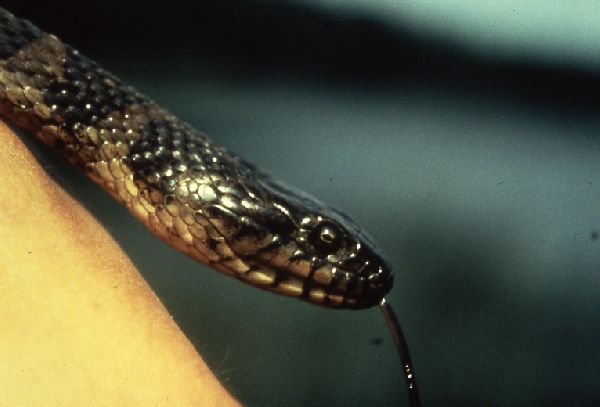
Description: This 2- to 3-foot-long snake comes in many color variations. Generally, it has a gray or brown background with red or brown bands near its neck, irregular patches on its back, a ringed tail, and spots on its sides. Newborn northern water snakes are 6 to 10 inches long. They grow to be 24 to 42 inches. Females are generally bigger than males. Color varies substantially in this species. The background color tends to be gray or brown and the markings are brown or reddish. Its belly is lighter colored with dark, crescent-shaped spots. Very large northern water snakes may appear completely brown or black. (MN DNR, 2022)
Food: These snakes eat frogs, turtles, fish, and other small animals found in their habitat. Sometimes they will round up fish or tadpoles with their long bodies and them eat them, or simply swim through a school of fish with their mouths open. Northern water snakes may also eat dead fish. (MN DNR, 2022)
Habitat: Northern water snakes live in vegetation along waterways. In Minnesota, they are most often found along the St. Croix and the Mississippi, especially in the southeast. Many winter in rock crevices, often with other snakes. They can swim well, and have been known to remain underwater for more than an hour at a time. (MN DNR, 2022)
Reproduction: Baby water snakes are born in June, July, or August. The mother gives birth to five to 60 young, sometimes over a period of several days. One female was observed to give birth to 99 babies. The young are 7 to 10 inches long. (MN DNR, 2022)
Conservation Status: Water snakes receive no special protection in Minnesota. (MN DNR, 2022)